On this Page
Locations and Facilities
The School of Medicine (SOM) has two dedicated simulation spaces within the Health Sciences District (HSD) in Kansas City, Mo. — Clinical Training Facility (CTF) and the Experiential Learning Center (ELC). The SOM’s St. Joseph, Mp. (STJ) Campus also has its own simulation center within the Medical Education Building.
Kansas City Locations
Clinical Training Facility (CTF)
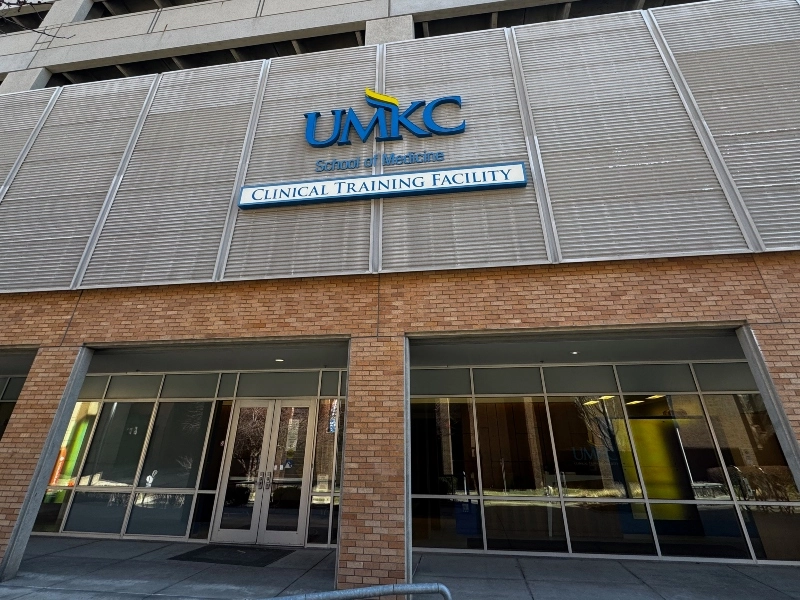
This 5,100-square-foot space is located on the lower level of the campus parking garage structure and is utilized for the teaching and assessment of communication skills, cognitive skills and procedural skills. Standardized Patient (SP) encounters and Objective Structured Clinical Examinations (OSCEs) for core clerkships occur in this space. Key features include four patient exam rooms, the Youngblood Medical Skills Laboratory and two classrooms.
CTF Features
Each room replicates a real-world clinical environment and is used for OSCE’s. Features include: The Youngblood Medical Skills Laboratory (YMSL) comprises four simulation skills areas within the CTF, each approximately 275 square feet. Spaces closely resemble acute care settings like emergency departments or ICU rooms; one area houses an anesthesia machine for related simulations. The YMSL is designed for clinical and cognitive skills training, including American Heart Association (AHA) courses such as BLS, ACLS, and PALS. It features a flexible configuration with three areas separated by mobile glass partitions, which can be opened for larger group training. Each classroom accommodates 16 participants and features a mobile dividing wall for a combined larger space. Classrooms are used for simulation event didactics, pre-briefing and debriefing.
Experiential Learning Center
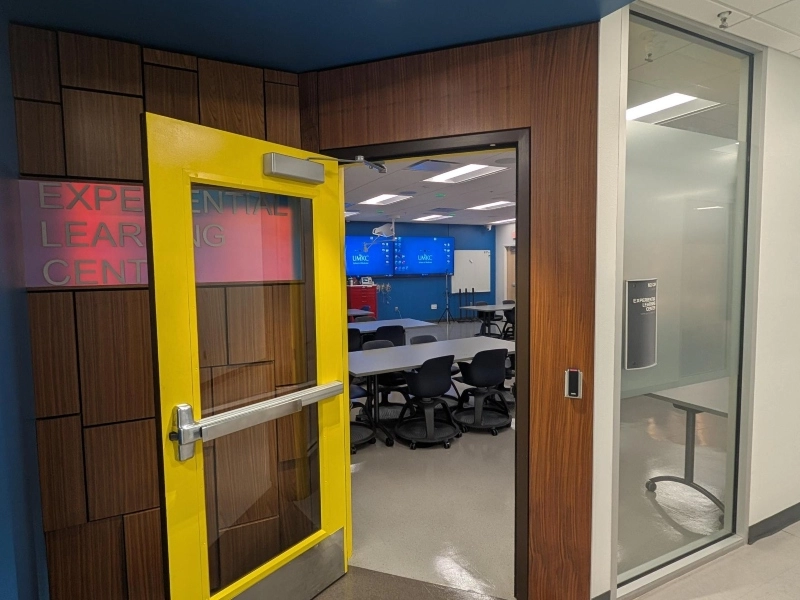
The Experiential Learning Center (ELC) is a 1,300-square-foot, newly renovated, flexible learning space located conveniently within the School of Medicine. It also houses over 100 anatomical models and the Harvey Simulator, available for use in pre-clinical courses. It is designed to support learners and faculty during business hours, after hours and virtually across campuses. The ELC’s versatile design supports a wide range of medical education activities.
The ELC is a multifunctional and flexible simulation space that can accommodate manikin-based, standardized patient and procedural simulations. It can also serve as a classroom and debriefing space with a seating capacity of up to 30 participants.
ELC Features
The patient examination room is designed to mimic a real-world patient examination room. Positioned adjacent to the 30-person classroom’s advanced AV features, it provides a creative solution for faculty who are teaching large group simulations or hybrid (in-person and remote) learners. The classroom is equipped with an operational headwall and necessary medical equipment for high-fidelity manikin-based simulations. A direct-view control room allows faculty to observe and assess learners discreetly, enhancing simulation fidelity, which is a unique feature compared to the Clinical Training Facility (CTF). The ELC houses advanced AV technology to assist in medical simulation training, including:
Simulation Center at the Healthcare Delivery and Innovation Building
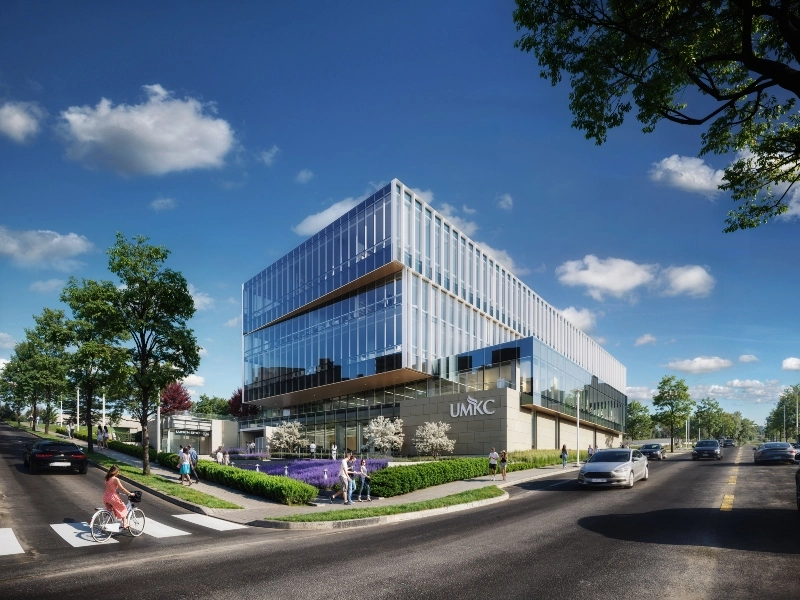
The Healthcare Delivery and Innovation Building (HDIB) is located in Kansas City's Health Sciences District and is a multi-story facility currently under construction and set to open Spring 2027. This space will house programs from the UMKC School of Medicine, School of Dentistry, Health Equity, Biomedical Engineering, and Data Science and Analytics.
The UMKC School of Medicine Simulation Center within the HDIB will cover approximately 12,000 square feet and is designed to more efficiently and adequately serve our large student body. Located on the first floor, the space has been built using best practices in simulation education, incorporating a zoned design to optimize event flow and flexibility.
Simulation Center at HDIB Features
This large, dedicated lab is designed specifically for procedural skills training and workshops. It can accommodate both large and small group learning. State-of-the-art AV technology supports cross-campus collaboration and remote skills teaching. Three centrally located debriefing rooms support the simulation events in the center. The environment is designed to promote post-event open dialogue and reinforce key clinical and communication skills. Our debriefing room provides a comfortable, technology-enabled space for post-simulation reflection and discussion. It is equipped with large displays for video playback, real-time feedback tools and flexible seating, which support facilitated conversation, performance review and team learning.
St. Joseph Locations
St. Joseph Medical Education Building
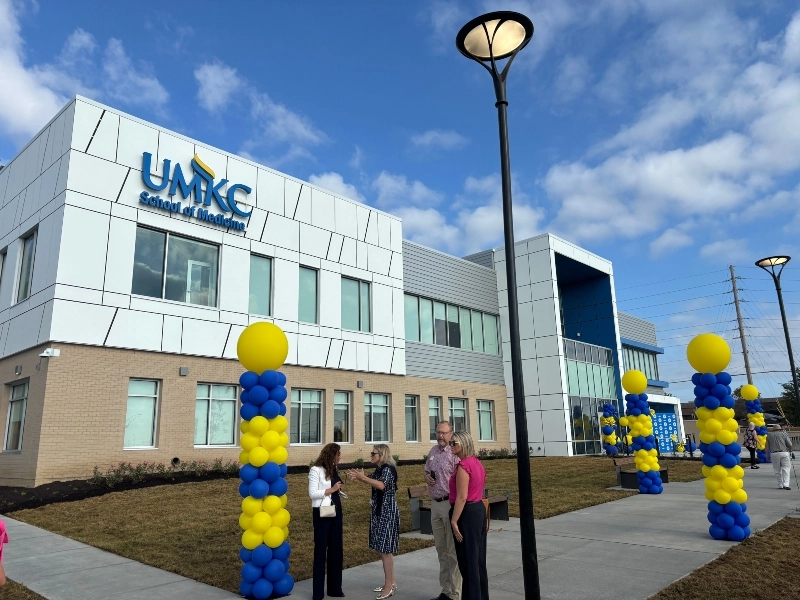
A 3,000-square-foot simulation center, with adjacent and additional didactic and flexible learning spaces, and student and administrative areas. The center is built to support the student body and ensures STJ medical students receive equitable clinical and procedural training without traveling to Kansas City.
STJ Medical Education Building Features
Each room replicates a real-world clinical environment and is used for OSCE’s, physical exam and communication hands-on learning. One debriefing room supports the simulation events in the center. The environment is designed to promote post-event open dialogue and reinforce key clinical and communication skills. Our debriefing room provides a comfortable, technology-enabled space for post-simulation reflection and discussion. It is equipped with large displays for video playback, real-time feedback tools and flexible seating. It supports facilitated conversation, performance review, and team learning.